India’s preparation for the World Cup

India’s preparation for the World Cup
The Indian men’s hockey team is preparing for the upcoming FIH Men’s Hockey World Cup, which will be held in Belgium and the Netherlands from August 14 to 30. Captain Harmanpreet Singh stated that the team has extensively worked on both offensive and defensive strategies. India secured direct qualification for the tournament after winning the men’s Asia Cup last year on home soil.
Harmanpreet mentioned that the training camp in Bengaluru concentrated on several key areas, including fitness, team structure, communication, and maximizing scoring opportunities within the opponent’s circle. He elaborated that the team focused on individual improvements in attacking and defensive play, as well as handling 50-50 chances. A significant emphasis was also placed on overall team defence.
The captain, who took a break earlier in the year, reported feeling refreshed and noted the encouraging performances from the younger players in the squad. He highlighted the importance of clear communication from senior players to build confidence among the newer members of the team. Harmanpreet expressed satisfaction with the team’s performances in the Pro League, where they finished eighth, and conveyed his excitement for the upcoming World Cup.
The team has also dedicated training time to penalty-corner attack and defence, positioning, and communication on the field. Harmanpreet indicated that they have worked on aggressive positioning in the opponent’s half and is content with the progress made in these aspects, now looking forward to applying these strategies in the tournament.
Coach’s perspective and tournament goals
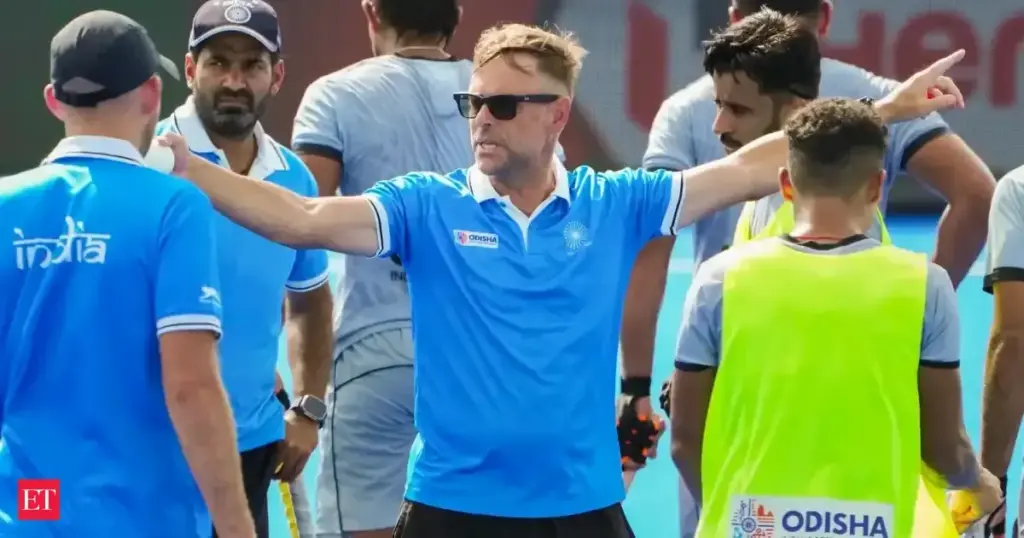
India is placed in Pool D alongside England, Wales, and Pakistan. Head coach Craig Fulton acknowledged the historical significance of the tournament, noting that it has been 51 years since India last won the World Cup. He expressed the team’s desire to create their own history in what he described as a challenging tournament. Fulton also pointed out a coincidence: the captain who lifted the trophy in 1975 was playing in his second World Cup, similar to Harmanpreet Singh’s current situation.
Fulton mentioned that the team is currently ranked eighth and has been given a 5-6% chance of winning the tournament, which he views as beneficial as it reduces pressure and allows the team to operate “under the radar.” The team has played a series of matches against strong opponents such as Pakistan, England, Germany, and Holland. Fulton conveyed that the players are highly motivated and focused on taking each game individually, understanding the importance of the tournament and the pride a podium finish would bring to Indian hockey.
The coach outlined the team’s dual objectives for the upcoming period: achieving a podium finish at the World Cup and winning the Asian Games to secure an Olympic qualification. He acknowledged the difficulty of succeeding in both tournaments, especially with the Asian Games starting just three weeks after the World Cup. Fulton explained that this schedule necessitated a different approach to training and preparation, particularly in strength and conditioning.
To manage the demands of back-to-back major tournaments, the team utilized a larger squad of 24 players, including 3-4 goalkeepers, to optimize performance and prevent injuries. Fulton believes that while this schedule does not disadvantage India at the World Cup, it could pose a challenge at the Asian Games, where other teams not participating in the World Cup will have a singular focus. He described the current squad as highly skilled, competitive, and confident, emphasizing a process-driven approach, with immediate focus on their first game against Wales on August 15.
Team strengths and leadership
When selecting the squad, Fulton prioritized connectivity and trust among players, along with versatility, past experience, and future potential. He aimed to integrate younger talent to gain exposure in major tournaments, ensuring a long-term vision for the team. The coach highlighted the team’s ability to adapt quickly as a key strength.
Fulton praised Harmanpreet Singh’s evolution as a captain, noting his increased responsibility as a key player. He emphasized the captain’s role in providing solutions to the team during challenging phases on and off the pitch, describing Harmanpreet as his “right arm” due to his crucial communication. The coach identified the team’s counter-attacking prowess and improved defensive philosophy as significant strengths. The team aims to press and counter from all areas, while also being capable of strong defence when needed.
To manage the pressure of expectations, Fulton stated that the team focuses on training and individual role definition. He believes that consistent execution of individual and collective tasks will lead to positive outcomes. The team is process-driven, tactically sound, and physically prepared. Mentally, the focus is on maintaining composure regardless of game situations, aiming to “bend, never break.” The importance of performing consistently from the first game to the last is a key psychological aspect for the team.
Source: timesofindia.indiatimes.com

